
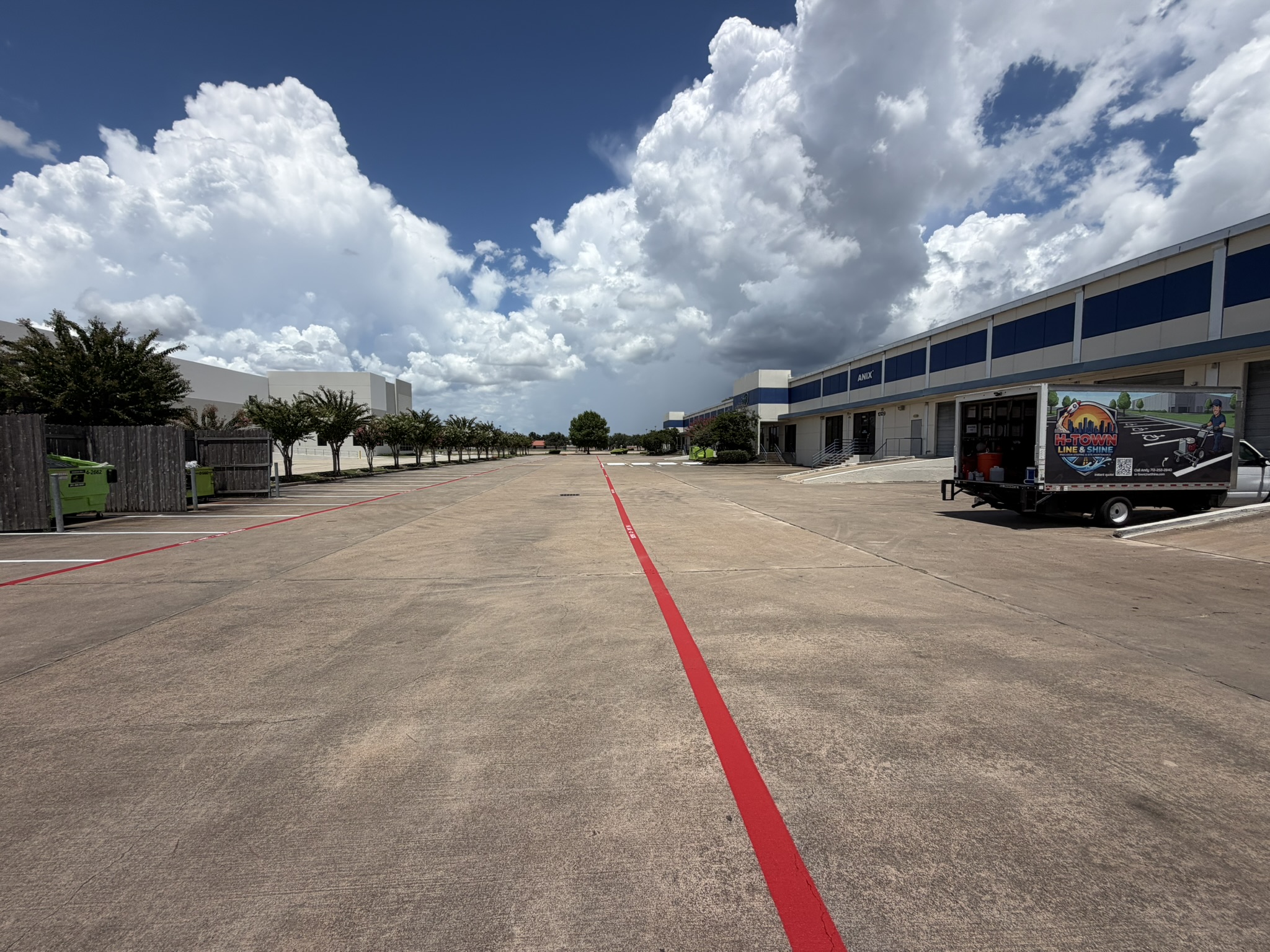
To maintain fire lane compliance in Texas, your parking lot striping requires a minimum 20-foot wide unobstructed apparatus access road, bordered by a 6-inch solid red stripe or red-painted curb. The wording “NO PARKING FIRE LANE,” “FIRE LANE NO PARKING,” or “FIRE LANE NO PARKING TOW-AWAY ZONE” must be stenciled in 4-inch white letters at intervals no greater than 25 to 30 feet, accompanied by vertical reflective signage depending on your city’s ordinances.

At H-Town Line & Shine, ensuring fire lane compliance is one of the most strictly enforced pavement requirements for Greater Houston businesses.
Unlike general parking stalls, fire apparatus access roads are governed by local fire marshals enforcing adapted versions of the International Fire Code (IFC). A single faded stripe, missing sign, or incorrect stencil spacing can lead to failed Fire Marshal inspections, heavy municipal fines, or emergency response delays.
Here is what local commercial property owners, general contractors, and developers need to know about Texas fire lane striping specifications.
1. Core Fire Lane Dimensions and Clearances
Fire apparatus access roads must accommodate full-sized fire engines and ladder trucks. The base dimensions across most Texas jurisdictions include:
- Minimum Roadway Width: 20 feet of continuous, unobstructed clear width. This extends up to 26 feet if a fire hydrant is located on the access road or if the structure requires aerial apparatus access (typically buildings over 30 feet tall).
- Vertical Clearance: Minimum 13 feet 6 inches of clear height (free from overhanging tree limbs, covered awnings, or utility lines).
- Weight Support: Structural pavement capacity supporting at least 90,000 lbs. of gross vehicle weight.
2. Pavement & Curb Painting Specifications
Painting a fire lane requires specific traffic paint formulations to resist sun bleaching, oil degradation, and heavy tire wear.
===================== 6″ Solid Red Border Stripe ===================
[ NO PARKING FIRE LANE ] ===> 25′-30′ Max Interval ===> [ NO PARKING FIRE LANE ]
============================================================
<=============================== 20′ Minimum Unobstructed Width =============================>
- Border Width: A 6-inch solid red stripe must outline both edges of the access roadway.
- Curb Face & Top: Where a curb is present, red traffic paint must cover both the vertical face and horizontal top of the curb.
- Paint Spec: Professional-grade acrylic traffic marking paint selected for the pavement or curb substrate and applied according to the manufacturer’s product data sheet.
3. Fire Lane Paint vs. Standard Stall Paint: Technical Differences
Fire lanes and standard parking stalls may use the same professional-grade acrylic traffic marking system. What changes are the required color, stencil wording, visibility, surface preparation, and the local fire marshal’s specifications.
Comparison: Standard Stall Paint vs. Fire Lane Coating
| Feature / Metric | Standard White/Yellow Stall Paint | Fire Lane Red Coating |
| Primary Binder Chemistry | Standard Fast-Dry Waterborne Acrylic | Professional-Grade Acrylic Traffic Marking Paint |
| Typical Application Thickness | 12 to 15 mils wet (~7 to 9 mils dry) | 15 to 18 mils wet (~10 to 12 mils dry) |
| Pigment Quality & UV Resistance | Standard titanium dioxide (white) or yellow iron oxide | High-purity organic red pigments with UV-stabilizers |
| Substrate Placement | Smooth asphalt or cured concrete | Vertical curb faces, concrete gutters, and rough joints |
| Chemical & Oil Resistance | Moderate (subject to tire marking and engine drip) | High resistance to brake fluid, oil runoff, and standing water |
Why Red Fire Lane Paint Requires Higher-Grade Formulations
Red organic pigments are naturally more prone to photo-degradation (UV fading) than white or yellow oxides. Under the intense Gulf Coast sun, lower-tier waterborne latex paints will chalk and turn pale pink within 6 to 9 months.
To meet Texas Fire Code visibility mandates over a multi-year lifecycle, proper fire lane application requires and that’s where H-Town Line & Shine can help:
- Higher Binder-to-Pigment Ratios: Quality acrylic traffic-marking paint helps retain color and adhesion under Houston sun, rain, and vehicle traffic.
- Superior Concrete Adhesion: Fire lanes frequently coat vertical concrete curbs and drainage gutters rather than flat asphalt. Concrete constantly off-gasses moisture and has a higher pH. Applying cheap waterborne paint over unprimed concrete leads to premature flaking and edge peeling.
- Correct Film Thickness (Mils Gauge): Standard stall lines suffer minimal wear beyond occasional tires. Fire lane curbs, however, take direct contact from tire sidewalls, delivery trucks, and street sweepers. Maintaining a minimum wet film thickness of 15 mils ensures the coating withstands mechanical abrasion without scraping off down to the raw concrete.
Engineering Tip: The Texas Department of Transportation (TxDOT) outlines strict specifications for traffic coatings (Item 666 / DMS-8200). Fire Marshals expect pavement markings to retain high contrast and color retention. Skimping on coat thickness or using cheap off-the-shelf paint to cut costs usually results in an early fail on the Fire Marshal’s annual life-safety inspection.
4. Stencil Wording and Spacing Rules
The stenciled wording informs drivers and provides legal backing for towing unauthorized vehicles and keeps your business in IFC compliance.
| Parameter | Harris County / IFC Standard | City of Houston Standard |
| Approved Wording | NO PARKING FIRE LANE or FIRE LANE NO PARKING | FIRE LANE NO PARKING TOW-AWAY ZONE |
| Letter Height | 4 inches minimum | 4 inches minimum |
| Letter Color | High-contrast white traffic paint | High-contrast white traffic paint |
| Maximum Interval | Every 25 feet along the line | Every 20 to 30 feet along the line |
5. Vertical Fire Lane Signage Requirements
Pavement markings alone are generally not sufficient under Texas fire codes. They must be paired with vertical, reflective enforcement signage.
- Sign Dimensions: Minimum 12 inches wide by 18 inches high.
- Design: Red retroreflective lettering on a white background with a border reading “NO PARKING – FIRE LANE”.
- Mounting Height: Bottom of the sign must sit between 4 feet and 7 feet above the grade.
- Placement Spacing: Installed at intervals no greater than 50 feet apart along the fire apparatus road.
6. Worked Example: A 400-Foot Commercial Fire Access Road
Consider a new distribution center in Pearland, TX, featuring a 400-foot-long concrete rear access drive.
[SIGN] [SIGN] [SIGN] [SIGN]
| | | |
============================================== (6″ Red Stripe)
[NO PARKING FIRE LANE] ===> (25 ft) ===> [NO PARKING FIRE LANE]
===========================================================================
400 Foot Access Road
===========================================================================
[NO PARKING FIRE LANE] ===> (25 ft) ===> [NO PARKING FIRE LANE]
=============================================== (6″ Red Stripe)
1. Pavement Line & Stencil Calculation
Both sides of the 400-foot lane must be painted:
- Linear Red Curb/Stripe: $400 \text{ ft} \times 2 \text{ sides} = \mathbf{800 \text{ linear feet of 6-inch red stripe}}$.
- Stencils Required: At a 25-foot maximum interval:
$$\frac{400 \text{ ft}}{25 \text{ ft}} = 16 \text{ stencils per side} \times 2 \text{ sides} = \mathbf{32 \text{ stencils total}}$$
2. Signage Calculation
- Signs Required: Placed at maximum 50-foot intervals on the primary side:
$$\frac{400 \text{ ft}}{50 \text{ ft}} + 1 \text{ (end sign)} = \mathbf{9 \text{ reflective signs mounted on steel posts}}$$
7. City of Houston vs. Harris County: Crucial Local Variations
One of the biggest traps for contractors and property managers in Greater Houston is assuming fire lane codes are identical everywhere.
- Unincorporated Harris County: Adopts the IFC with specific county amendments requiring 6-inch red borders with 4-inch white stencils every 25 feet on both sides.
- City of Houston Proper: Governed by the City of Houston Fire Code and HFD Life Safety Bureau (LSB) Standards No. 03.
- Surrounding Municipalities (Katy, Sugar Land, The Woodlands): Municipal fire marshals often add local amendments regarding turnarounds (hammerheads vs. cul-de-sacs) and tow-away wording.
H-Town Line & Shine can assist you with these critical layouts.
8. How to Pass Your Fire Marshal Inspection
If you are opening a new building, modifying an existing footprint, or completing an annual maintenance audit, H-Town Line & Shine will help keep these audit checkpoints in mind:
- Check for Fading: Sun exposure in South Texas rapidly fades red traffic paint to pink. Faded fire lanes do not meet contrast codes and can be cited.
- Verify Vehicle Encroachment: Ensure standard parking stall lines near the fire lane give vehicles enough room to park without overhanging bumpers into the 20-foot clear width.
- Audit Sign Visibility: Ensure vertical signs are not hidden behind unpruned trees or landscaping.
Frequently Asked Questions
What type of paint is needed for fire lane striping vs. regular parking stalls?
Fire lanes require durable red traffic-marking paint and high-contrast white stencil paint that are compatible with the pavement or curb. H-Town Line & Shine uses professional Sherwin-Williams acrylic traffic-marking paint and follows the product data sheet plus the local fire marshal’s requirements.
What paint color is required for fire lanes in Texas?
Texas fire codes require red traffic paint for fire lane borders and curbs, with white traffic paint used for the stenciled lettering. Yellow curb paint generally denotes general traffic loading or no-parking zones rather than designated fire lanes.
How often should fire lane striping be repainted?
Most commercial fire lanes in Houston require repainting every 12 to 24 months, depending on traffic volume and sun exposure. Fire Marshals can issue non-compliance citations if red paint turns pink or stencils become unreadable.
Can a property owner tow cars parked in a fire lane?
Yes, provided the fire lane is marked in accordance with local fire codes and Texas Transportation Code requirements, including visible red border striping, correct stenciling, and posted vertical signs with tow-away wording.
Need Code-Compliant Fire Lane Striping in Houston?
Avoid inspection delays and civil liability with precise, fire-code-compliant pavement markings.
Leave a Reply