
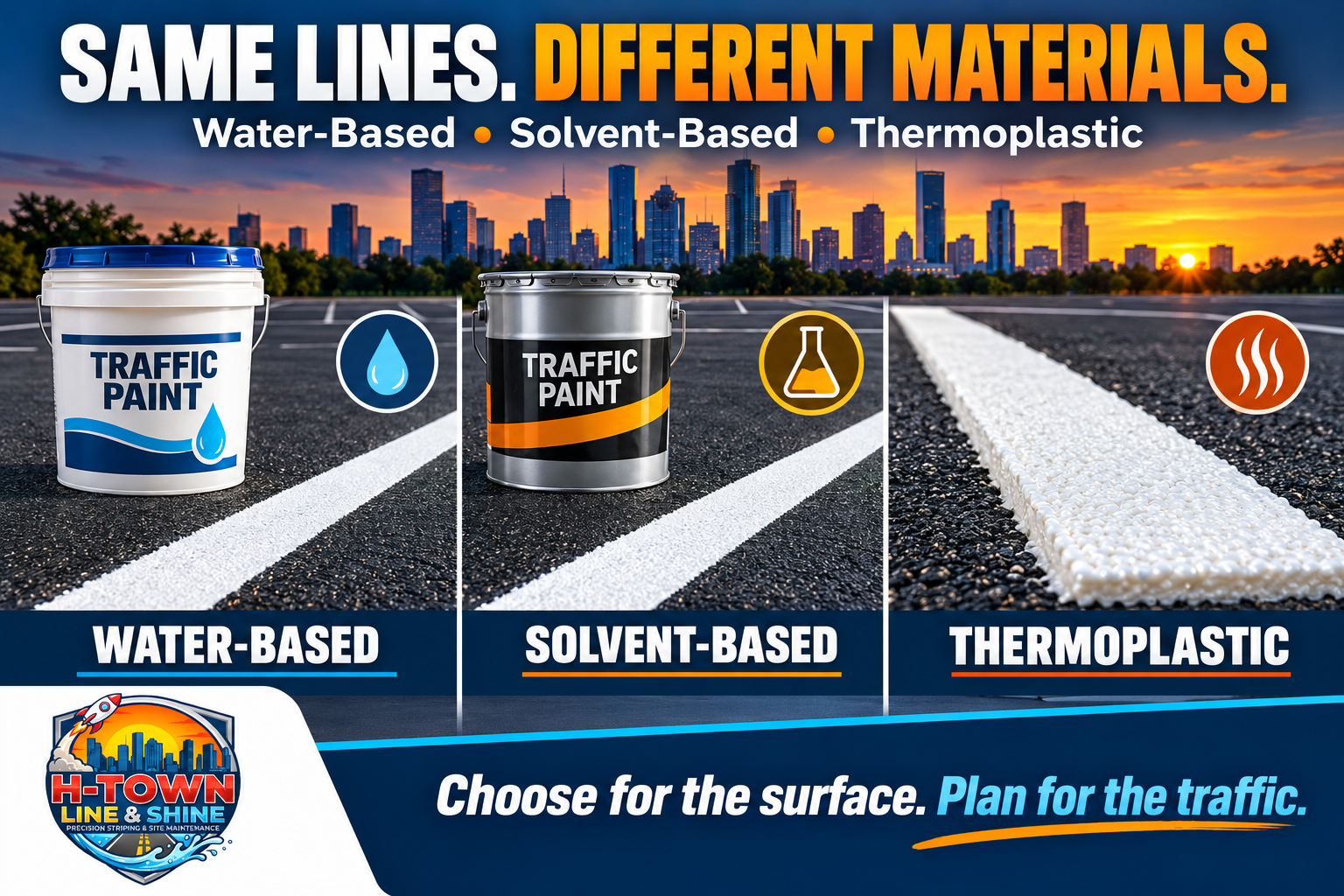
Water-based and solvent-based traffic paints can both be practical choices for parking lot restriping. Thermoplastic is worth considering for selected markings exposed to frequent traffic and wear. The right choice depends on your pavement, traffic patterns, maintenance budget, and application conditions, not simply which material sounds toughest.
For Houston property managers, the goal is clear markings that hold up, with a realistic plan for installation and future maintenance.
The quick comparison
- Water-based traffic paint: Typically lower VOC content and straightforward cleanup. A practical option for routine parking spaces and planned maintenance.
- Solvent-based traffic paint: Available in fast-drying formulations, including products suited to cooler application conditions. A practical option for parking lots when the specified product fits the surface and schedule.
- Thermoplastic: A heat-applied marking system with greater upfront installation cost in many projects. Worth evaluating for stop bars, arrows, crosswalks, and other high-wear markings.
Paint generally costs less to install than thermoplastic. Water-based versus solvent-based pricing depends on the actual product and scope, so a fixed ranking can be misleading. Compare complete installed quotes, not just material prices. Sources: FHWA cost-effectiveness analysis.
Water-based traffic paint: a practical maintenance option
Water-based, or waterborne, traffic paint commonly uses an acrylic binder. Products are available for both asphalt and concrete, provided the pavement is properly prepared and the coating is approved for that surface.
Its advantages include typically lower VOC content than conventional solvent-based paint and water-based cleanup. It can work well for apartment communities, retail centers, offices, and other properties with a regular restriping plan.
The main scheduling concern is moisture. High humidity, dew, and approaching rain can affect application and drying. A fast-dry label does not override the manufacturer's weather limits. Sources: Sherwin-Williams Pro-Park product data, PPG waterborne paint product data.
Solvent-based traffic paint: look at the formulation
Solvent-based paint uses organic solvents rather than water as its main carrier. Some formulations offer useful application flexibility in cooler conditions, but temperature limits and performance vary by product. Sources: PPG solvent-based traffic paint.
At H-Town Line & Shine, our striping materials include Sherwin-Williams ProMar Solvent Based Acrylic Traffic Marking Paint. Its manufacturer identifies it as an acetone-based acrylic coating for properly prepared surfaces including cured asphalt and concrete. Sources: Sherwin-Williams ProMar product data.
Solvent-based does not automatically mean longer-lasting, and water-based does not automatically mean inferior. Compare adhesion, film thickness, wear exposure, and the specific coating system. Solvent handling, ventilation, ignition precautions, and cleanup requirements also deserve attention.
Thermoplastic: consider it where wear justifies the investment
Thermoplastic is different from ordinary traffic paint. Hot-applied material is melted before installation; preformed markings arrive in shapes that are heated onto the pavement. The material hardens as it cools. Sources: PPG pavement marking materials.
A suitable, correctly installed thermoplastic system can outlast conventional paint, making it worth evaluating where tires repeatedly cross important markings. That does not make it the best choice for every parking stall. Installation equipment, heat, preparation, and potential removal add to the project cost.
Surface compatibility is especially important. Thermoplastic can form a thermal bond with asphalt. Concrete needs a compatible product and may require a primer or sealer; aged asphalt may need one too. Primer is not a substitute for dry pavement. Follow the specific system's installation instructions. Sources: FHWA cost-effectiveness analysis, TxDOT pavement marking handbook.
Houston weather and surface preparation matter
Before choosing a material, check the pavement underneath it. Oil, dirt, loose paint, concrete curing compounds, and incompatible existing coatings can undermine adhesion. New asphalt or sealcoating also needs sufficient time before striping, according to the relevant product instructions. Sources: Sherwin-Williams Pro-Park product data, PPG waterborne paint product data, Sherwin-Williams ProMar product data.
After rain or surface cleaning, allow the pavement to dry adequately. Check surface temperature, humidity, dew point, and the rain forecast. Switching to solvent-based paint does not make wet pavement acceptable.
Dry-to-touch is not the same as ready for every use
Dry-to-touch, no-pickup, no-track, and full cure or hardness development describe different performance milestones. A published no-track time is not a blanket guarantee that fresh markings are ready for heavy vehicles, tight turns, or cleaning.
Use the selected product's instructions and actual site conditions to set reopening times. Thermoplastic also needs adequate cooling and bond verification. For scheduling considerations, see our Houston parking lot striping drying-time guide. Sources: Sherwin-Williams Pro-Park product data, PPG waterborne paint product data, Sherwin-Williams ProMar product data, TxDOT pavement marking handbook.
Compare lifetime cost and environmental tradeoffs
There is no dependable lifespan for an entire material category. Traffic volume, turning tires, pavement condition, preparation, and application thickness all influence how quickly markings wear.
Compare the initial installation with expected touch-ups, closures, removal, and your next resurfacing project. A mixed approach may make sense: paint for routine spaces and a suitable durable system for selected high-wear markings. Sources: FHWA cost-effectiveness analysis.
Water-based paint typically reduces VOC emissions compared with conventional solvent-based alternatives, but low-VOC solvent products also exist. Thermoplastic is a solids-based system that requires heat. Product chemistry, installation energy, replacement frequency, and waste handling all matter; no category is automatically the greenest. Sources: PPG solvent-based traffic paint, PPG pavement marking materials, PPG waterborne coatings guide.
Common questions
Is thermoplastic always better than paint?
No. Its potential wear advantage must justify the cost and suit the pavement, layout, and maintenance plan.
Can all three be used on concrete?
Suitable products exist, but compatibility and preparation vary. Thermoplastic often needs a concrete-specific system and primer.
Does solvent-based paint always dry faster?
No. Compare the actual products under the same temperature, humidity, and film-thickness conditions.
Get a quote for your Houston property
H-Town Line & Shine brings German Precision™ to parking lot striping across Greater Houston. Request a quote to discuss your pavement, existing markings, and maintenance goals.
Leave a Reply